

Entry-level EVs look great on paper.
Low energy cost. Minimal maintenance. Tax credits. The numbers seem to line up.
But here's what the brochures don't tell you. For some drivers, a used hybrid comes out ahead on total cost. Not close. Ahead.
I ran the comparison for a few common scenarios. The results surprised me the first time.
Here's when the cheaper EV actually costs more.
The Problem With Entry-Level EVs
Entry-level EVs — the ones priced at or below the average new car transaction price — come with compromises.
Range is often limited to 150 miles or less in ideal conditions. Winter cuts that by 20 to 30 percent. Highway driving cuts it further.
Charging speed is usually slower than premium EVs. A full charge can take hours on Level 2. Fast charging, if available, is often capped at 50 kW.
And the purchase price, while lower than premium EVs, is still significantly higher than a comparable used hybrid.
Those compromises don't matter to every driver. But for some, they turn the EV from a smart decision into an expensive experiment.
Scenario One: No Home Charging
This is the most common way the math breaks.
Take a driver who rents an apartment. Street parking. No garage. No outlet near where they park.
Entry-level EV assumptions:
Purchase price: $30,000 (after partial tax credit)
Energy cost: Public fast charging only at $0.45 per kWh
Annual miles: 12,000
Used hybrid assumptions:
Purchase price: $18,000 (three to four years old, 40,000 to 50,000 miles)
Fuel cost: $3.50 per gallon, 48 mpg combined
Annual miles: 12,000
Here's how the five-year totals compare.
Cost Category | Entry-Level EV | Used Hybrid |
|---|---|---|
Purchase price | $30,000 | $18,000 |
Energy/fuel over 5 years | $8,450 | $4,375 |
Maintenance over 5 years | $750 | $2,000 |
Estimated resale value after 5 years | $12,000 | $8,000 |
Total cost after resale | $27,200 | $16,375 |
The used hybrid costs about ten thousand dollars less over five years.
The EV's higher purchase price never recovers. Public charging eliminates the energy cost advantage. And the hybrid's lower upfront price wins even with higher maintenance.
Scenario Two: Short Ownership Period
Some people keep cars for two or three years, not five. Maybe they lease. Maybe they trade frequently. Maybe their life changes.
EVs take time to pay off the higher purchase price through operating savings. If you sell before that break-even point, you never get the savings.
Entry-level EV assumptions (three-year ownership):
Purchase price: $30,000
Energy cost: Home charging at $0.14 per kWh
Annual miles: 12,000
Used hybrid assumptions (three-year ownership):
Purchase price: $18,000
Fuel cost: $3.50 per gallon, 48 mpg
Annual miles: 12,000
Cost Category | Entry-Level EV | Used Hybrid |
|---|---|---|
Purchase price | $30,000 | $18,000 |
Energy/fuel over 3 years | $1,575 | $2,625 |
Maintenance over 3 years | $450 | $1,200 |
Estimated resale value after 3 years | $18,000 | $12,000 |
Total cost after resale | $14,025 | $9,825 |
The hybrid still wins by a meaningful margin.
Even with cheap home charging, the EV's higher depreciation in the first three years outweighs the operating savings. The hybrid loses less value and costs less upfront.
Scenario Three: Low Annual Mileage
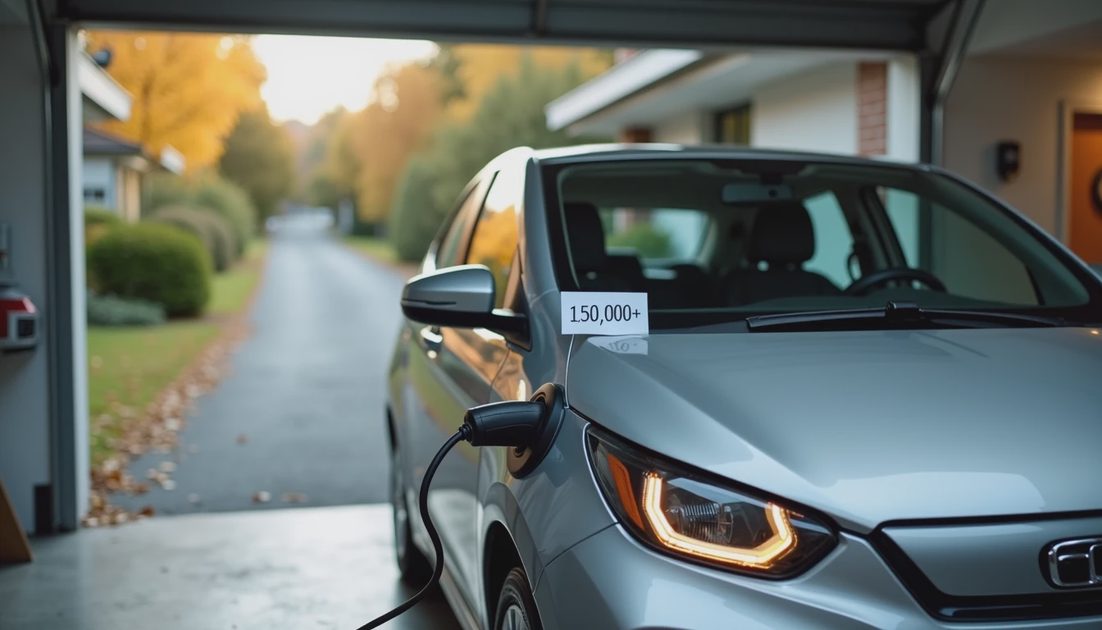
EV math works best when you drive enough miles to generate significant fuel savings. If you drive less, the savings shrink.
Entry-level EV assumptions:
Purchase price: $30,000
Energy cost: Home charging at $0.14 per kWh
Annual miles: 6,000 (half the average)
Used hybrid assumptions:
Purchase price: $18,000
Fuel cost: $3.50 per gallon, 48 mpg
Annual miles: 6,000
Cost Category | Entry-Level EV | Used Hybrid |
|---|---|---|
Purchase price | $30,000 | $18,000 |
Energy/fuel over 5 years | $1,315 | $2,185 |
Maintenance over 5 years | $750 | $2,000 |
Estimated resale value after 5 years | $12,000 | $8,000 |
Total cost after resale | $20,065 | $14,185 |
Same pattern. The hybrid wins.
At lower miles, the EV's energy savings are smaller. The purchase price difference dominates the calculation. You never drive enough to make up the gap.
When the EV Wins
I'm not anti-EV. The math just has to work.
The entry-level EV beats a used hybrid in these scenarios.
Home charging available. This is non-negotiable for EV cost savings. Without it, the math almost never works.
High annual mileage. Over 15,000 miles per year. That's where the energy savings add up fast enough to overcome the purchase price gap.
Long ownership. Five years minimum. Seven is better. You need time for the operating savings to accumulate.
Tax credits that actually apply to you. Not everyone qualifies for the full credit. Check your eligibility before you assume it applies.
Here's how that winning scenario looks.
Cost Category | Entry-Level EV | Used Hybrid |
|---|---|---|
Purchase price (with full tax credit) | $27,500 | $18,000 |
Energy/fuel over 5 years (15,000 miles/year) | $3,280 | $5,470 |
Maintenance over 5 years | $750 | $2,000 |
Estimated resale value after 5 years | $11,000 | $7,000 |
Total cost after resale | $20,530 | $18,470 |
The EV still costs more, but the gap is smaller. Over seven years, the EV would likely pull ahead.
But that's a specific set of conditions. Home charging. High miles. Long ownership. Full tax credit. Change any one of those, and the used hybrid starts looking better again.