

An affordable SUV looks great on the lot.
Reasonable price. Good space. Decent fuel economy. The monthly payment fits your budget.
Then you own it for a year. You replace the tires. You pay the insurance bill. You renew the registration. And the "affordable" SUV starts looking less affordable.
Here's what those overlooked costs actually do to your total ownership number.
Tire Costs: The Surprise That Shows Up at 40,000 Miles
Affordable SUVs come with affordable-looking price tags. They do not come with affordable tires.
Why? Size and weight.
An SUV is heavier than a sedan. Heavier vehicles need more tire. More rubber. Stronger construction. That costs more.
A compact sedan might wear 16-inch or 17-inch tires. A typical SUV wears 17-inch, 18-inch, or even 19-inch tires. The price jumps with every inch.
Here's what a typical set of all-season tires costs for different vehicle types.
Vehicle Type | Tire Size Range | Cost Per Tire | Full Set Cost |
|---|---|---|---|
Compact sedan | 15-16 inch | 100 to100to150 | 400 to400to600 |
Midsize sedan | 16-17 inch | 120 to120to180 | 480 to480to720 |
Compact SUV | 17-18 inch | 150 to150to220 | 600 to600to880 |
Midsize SUV | 18-19 inch | 180 to180to280 | 720 to720to1,120 |
The SUV costs hundreds more per set. And SUVs often go through tires faster than sedans because of weight and suspension geometry.
I've watched people buy an SUV for the same price as a sedan, then spend significantly more on tires every 40,000 to 50,000 miles. They didn't budget for it because they looked at the window sticker, not the tire rack website.
Insurance: The Cost That Doesn't Follow the Purchase Price
Insurance companies don't price coverage based on what you paid for the car. They price based on what it costs to fix and what happens when it crashes.
SUVs score worse on both.
Repair costs are higher because parts are larger and body work is more extensive. Labor rates are the same, but there's more to do.
And SUVs have higher average claim costs in crashes because they cause more damage to other vehicles. Insurance spreads that cost across all SUV owners.
The sedan owner spends that money on something else. The SUV owner spends it on insurance.
Registration and Taxes: The Annual Surprise
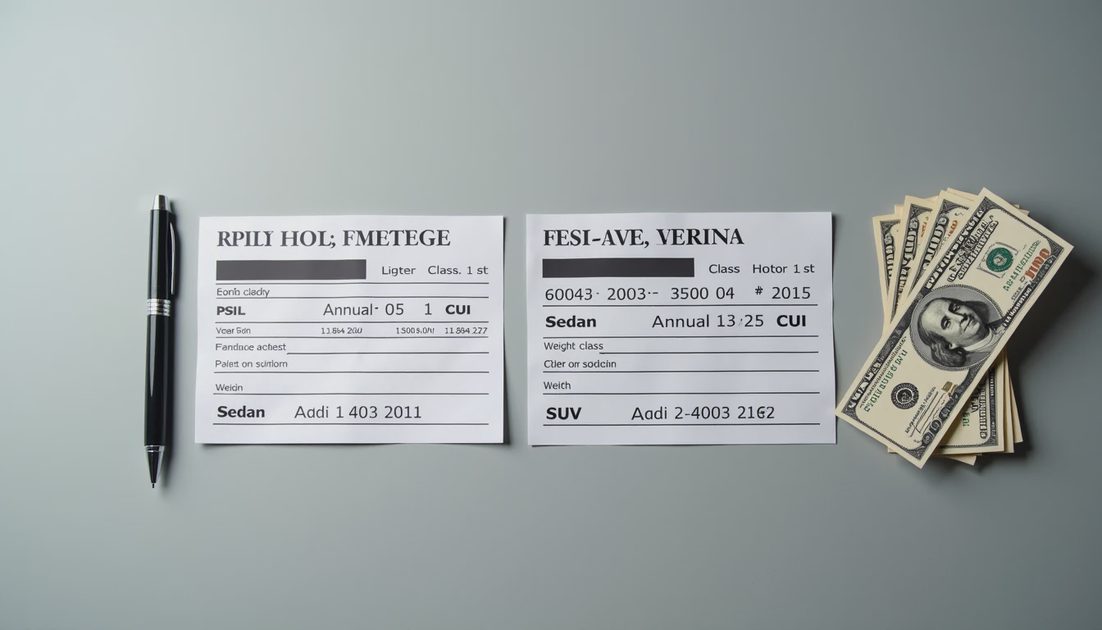
Registration fees are often based on vehicle weight, age, and original value. SUVs are heavier than sedans. Some states also add surcharges for SUVs and trucks.
The difference per year might be modest. Fifty dollars. Eighty dollars. A hundred dollars.
But it's every year. And it's money you cannot reduce by driving carefully or choosing cheaper parts.
Not the biggest line item. But it's guaranteed. Every year. No way around it.
Putting It All Together
Let me show you what happens when you add these costs to two vehicles at the same purchase price.
Compact sedan: 22,000 purchase price. Compact SUV:22,000purchaseprice.CompactSUV:22,000 purchase price.
Same upfront cost. Same monthly payment if financed identically.
Now add the costs the dealer doesn't mention.
Cost Category | Compact Sedan (5 Years) | Compact SUV (5 Years) |
|---|---|---|
Tires (one set) | $550 | $750 |
Insurance | $6,500 | $7,500 |
Registration | $500 | $650 |
Total hidden cost difference | $7,550 | $8,900 |
The SUV costs an extra $1,350 over five years. Same purchase price. Same monthly payment. Higher total cost.
And that's before we talk about fuel economy, which usually favors the sedan by another modest amount.
When the SUV Still Makes Sense
I'm not saying don't buy an SUV. I'm saying know what you're paying for.
The SUV makes sense when you actually need what it offers.
Cargo space for large items. The sedan trunk won't fit a stroller and a week of groceries? Get the SUV.
AWD or 4WD for snow or light off-road. Indy winters can be rough. If you live on a poorly plowed street, the extra traction has real value.
Easier entry and exit. For taller drivers or passengers with mobility issues, the higher seat height is not a luxury. It's a necessity.
Towing capacity. Sedans don't tow. Some SUVs do.
These are real benefits. They have value. The question is whether that value is worth the higher operating costs.
For many drivers, the answer is yes. For many others, they're paying for capability they never use.
The Question You Should Ask Yourself
Before you buy an affordable SUV, ask this.
Do I need the SUV body style, or do I just think I do?
If you drive alone or with one passenger, mostly on paved roads, and never carry large items, a sedan or hatchback does everything you need for less money.
If you have kids, gear, rough winters, or an active outdoor life, the SUV might be worth the premium.
But don't assume the SUV is the default choice just because everyone drives one. Everyone is also spending more on tires, insurance, and registration than they need to.
A Better Way to Compare
When I compare a sedan and an SUV at the same price, I add three lines to my spreadsheet.
Estimated tire replacement cost based on actual tire prices for that specific model.
Insurance quote for that specific model, not an average.
Registration fee for my county based on vehicle weight class.
Then I look at the five-year total. Not the monthly payment. Not the window sticker.
Sometimes the sedan wins by enough to buy a nice vacation. Sometimes the SUV's benefits justify the extra cost. But I don't guess. I run the numbers.