

I get asked the same question all the time.
"Is this car a good deal?"
My answer is always the same: "Give me five minutes with five numbers, and I'll tell you."
Most people look at the sticker price and the monthly payment. That's like judging a house by the front door color. You're missing everything that matters.
Here are the five numbers I run on every car before I say yes or no.
Number 1: Depreciation at Year 3 and Year 5
A new car loses value the second you drive it off the lot. You know this. What you probably don't know is how much and when it slows down.
I look up the projected value at 36 months and 60 months. Not percentage. Actual dollars.
Two cars can cost the same new but have very different depreciation curves. One holds value better. The other drops faster. That difference adds up to real money over time.
If you sell at year 5 and the gap has grown, the car that held value better was cheaper to own — even if the monthly payments were identical.
What I'm looking for: A depreciation curve that flattens by year 3. That's usually your sell window. Hold too long and the drop starts again.
Number 2: Annual Maintenance Probability
Not the average cost. The probability of a big repair.
I don't care if the oil change is slightly more or less expensive. I care about whether this model has a known failure after the warranty runs out that costs real money to fix.
Some cars are boringly reliable. Some are beautiful disasters after the warranty ends.
I pull data from owner forums, repair databases, and consumer reports. I'm looking for patterns. If I see ten people describing the same transmission problem at the same mileage, that's not bad luck. That's a design flaw.
What I'm looking for: Models with no repeated major failures before 100,000 miles. Everything else is a red flag.
Number 3: True Energy Cost Per Mile
Dealerships and reviews love to give you the best-case fuel economy. Highway, flat road, no wind, perfect temperature.
I don't use that number.
I calculate based on your actual driving. City mix. Winter temperatures (Indy winters are real). Traffic patterns.
For EVs, I factor in cold weather range loss and public charging rates if you can't charge at home. The math changes completely depending on whether you have a garage.
For gas cars, I use real-world MPG from owner data, not the window sticker.
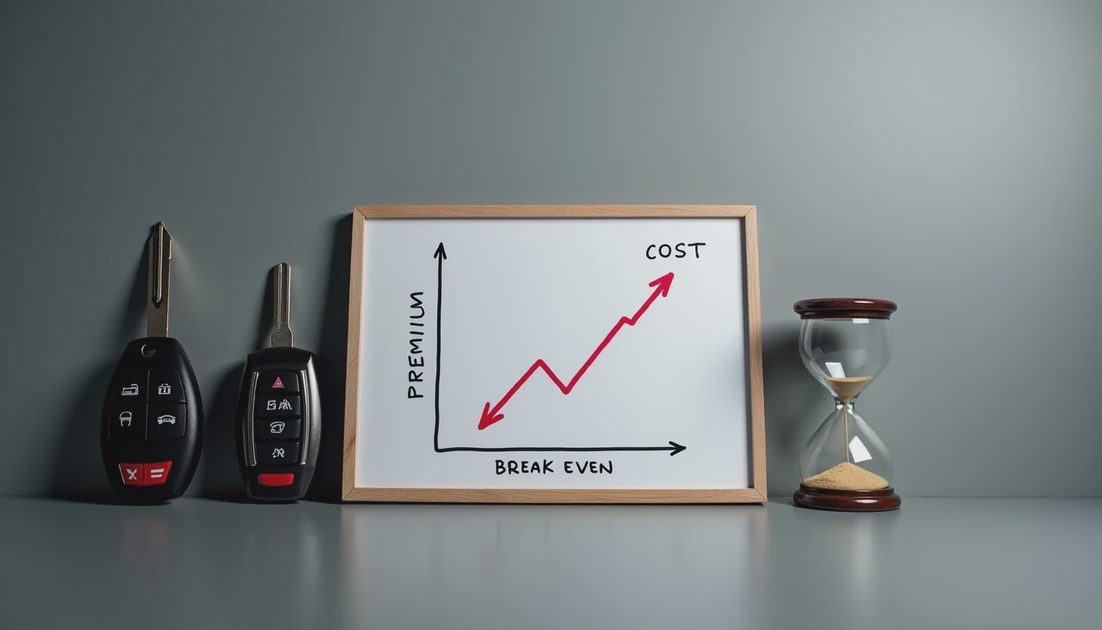
What I'm looking for: The break-even point where a hybrid or EV actually saves you money compared to a gas car, given your miles per year and your local energy prices.
Number 4: Insurance Difference by Model
This one surprises people.
Two cars with the same price can have insurance costs that are significantly different per year.
I've seen vehicles at the same price point vary by hundreds of dollars annually for the same driver, same city, same coverage. The difference comes down to repair costs, theft rates, and accident statistics for that specific model.
I run quotes before I even test drive. No surprises later.
What I'm looking for: Models that don't punish you on insurance. A moderate annual difference adds up to a meaningful amount over five years.
Number 5: The 60-Month Total Cost
This is where I put everything together.
Purchase price minus projected resale value. Plus estimated maintenance. Plus energy cost. Plus insurance. Plus taxes and fees.
One number. The total cost of ownership over five years.
Then I divide by 60. That's your true monthly cost. Not the payment. The cost.
Here's what usually happens: The car with the lower payment often has a higher true monthly cost because it depreciates faster or breaks more often. The payment is a distraction. The total cost is the truth.
What I'm looking for: A number that fits your budget without stretching. If the true monthly cost is more than a reasonable percentage of your take-home pay, the car is too expensive. I don't care what the dealer says you qualify for.
An example from my own spreadsheet
I once compared two used cars at similar price points.
One had a slightly lower purchase price and better fuel economy. Looked like the smarter choice on the surface.
But that car's depreciation at year 5 was worse. Insurance was higher each year. And it had a known issue at a certain mileage that would cost real money to fix.
The other car cost more upfront. But after I ran all five numbers, it was cheaper across five years by a meaningful margin.
I bought the second car. Still have it. Numbers haven't changed.
Use these five numbers
You don't need to be a procurement analyst to do this. You just need to slow down and ask the right questions before you sign.
Next time someone tells you a car is "a good deal," ask them for these five numbers.
If they can't give them to you, they're not qualified to answer the question.
I am.
One rule. No exceptions.
If the numbers don't work, the car doesn't work.