
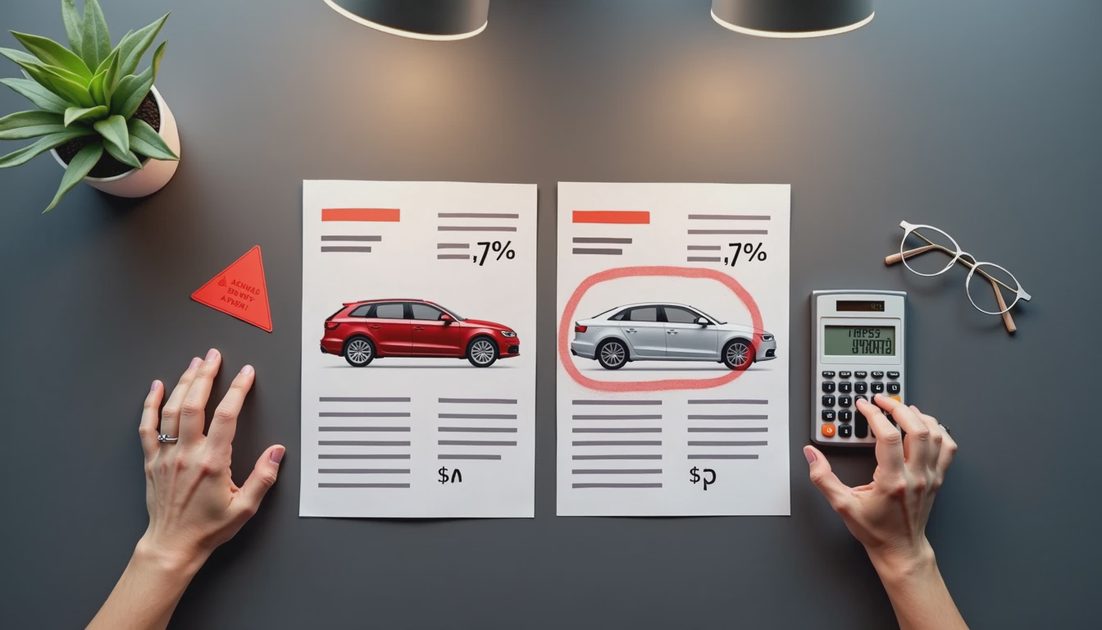
A used car listing is marketing. Not data.
The dealer wrote it to make the car look good. The angles hide the scratches. The description uses words like "reliable" and "clean" that don't mean anything. The price is adjusted to catch your eye, not to tell you what the car is worth.
You don't need to spend an hour studying every listing. Most of them fail the same few checks.
Here's how I read a used-car listing in under three minutes. If it passes these checks, I look closer. If it fails, I move on.
Minute One: The Price

I look at the price first. Not to see if it's "good." To see if it's real.
A price that's significantly lower than every comparable listing is not a deal. It's a warning. There's a reason it's cheap. Maybe it has a salvage title. Maybe it's been in an accident the listing doesn't mention. Maybe the dealer adds fees later to make up the difference.
I check the price against two sources. The average listing price for the same model, year, and mileage range. And the private party value from a standard guide.
If the listing price is more than fifteen percent below average, I don't get excited. I get suspicious.
A price that's above average isn't automatically bad. Some cars are worth more because they're cleaner, have better options, or come from a dealer with a strong reputation. But I need to see why.
The price tells me whether to keep reading or close the tab. Most listings fail in the first thirty seconds.
Minute Two: The Title Status and Photo Quality
Two things tell me more about a car than any text description.
The title status. Clean. Salvage. Rebuilt. Reconstructed.
If it's anything other than clean, I close the tab. I'm not saying you can never buy a rebuilt title car. I'm saying it's not for most people. Financing is harder. Insurance is sometimes harder. Resale is much harder. And the reason it was totaled in the first place matters.
For a normal buyer looking at a normal car, clean title only.
The photo quality tells me how the seller thinks about the car.
Multiple photos. Good lighting. Interior included. Underhood included. No weird angles hiding damage.
If the listing has two photos taken in the dark from twenty feet away, the seller is hiding something or doesn't care. Either way, I'm not interested.
I spend the second minute looking at title status and photo quality. If either fails, I stop.
Minute Three: The Odometer and Service History
If the price and title and photos all look reasonable, I go to the odometer.
Mileage alone doesn't tell me much. A well-maintained car with higher mileage is often better than a neglected car with low mileage.
But mileage tells me where to look next.
Under 30,000 miles. The car is still early in life. I'm mostly looking for accident history and whether the break-in maintenance was done.
Between 60,000 and 90,000 miles. This is the major service zone on many cars. I want to see if the timing belt, water pump, transmission service, or spark plugs have been done. If not, I'm buying those expenses.
Over 100,000 miles. I want service records. Not promises. Receipts or a Carfax showing regular maintenance. Without records, I assume the maintenance hasn't been done.
I also look for one specific thing in the listing text. "Maintenance records available." Even better, "Timing belt replaced at 80,000 miles." A seller who kept records is a seller who probably took care of the car.
If the listing has no service history and the mileage is over 60,000, I'm done. That's too much unknown.
What I Don't Waste Time On
The prose description. "Runs great." "Very clean." "Loaded." None of that means anything. Every listing says the same things.
The blue book value claim. "KBB says this car is worth..." I don't care what KBB says. I care what similar cars are actually selling for in my market.
The "lady driven" or "highway miles" claims. Unprovable and usually irrelevant.
The financing offers. I sort financing separately. The listing's "low monthly payment" is designed to distract me from the total price.
I ignore all of this. It's noise.
The Test I Run After Three Minutes
If a listing passes the three-minute check, I run one more quick test.
I search for the same model and year within a hundred miles. I sort by price and look at the bottom five listings. Those are the cheapest examples on the market.
Then I ask myself: what's wrong with those cheap cars that isn't wrong with this one?
If I can't find a clear difference — mileage, condition, title status, options — then this listing's price might be too high. The market has cheaper examples for a reason.
If I can see why this one costs more — lower miles, cleaner photos, service records mentioned — then the price might be fair.
This test takes thirty seconds and saves me from overpaying.
An Example
I looked at a five-year-old sedan recently. The price was a bit above average. My first reaction was "too high."
Three minute check. Price was above average, but not dramatically. Clean title. Eight good photos including interior and underhood. Mileage was low for the year. The listing specifically said "all service records available from local dealership."
That last line changed everything. Low mileage plus documented service history is rare. The higher price made sense.
I went to see the car. The service records were complete. I bought it. The math worked.
If I had dismissed the listing because the price was above average, I would have missed a good car.
The three minute check isn't about filtering everything out. It's about filtering the noise so you know which listings deserve your time.