
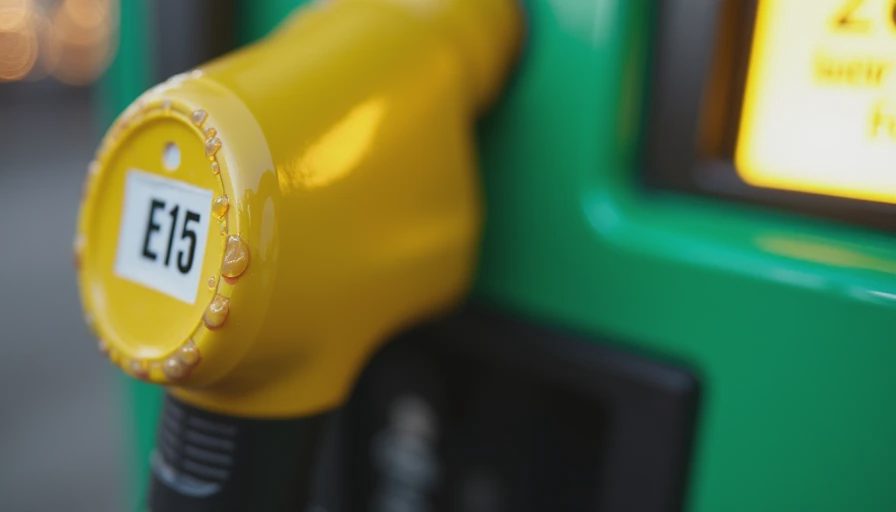
If you've looked at a gas pump recently, you've probably seen the option for gasoline e15 fuel. It's labeled as "Unleaded 88" or "E15" at many stations. But is this fuel blend safe for your vehicle? And does it actually save you money at the pump? Let's run the numbers and cut through the hype.
What Exactly Is Gasoline E15 Fuel?
Gasoline e15 fuel is a blend of 85% gasoline and 15% ethanol by volume. Ethanol is an alcohol-based renewable fuel typically made from corn in the U.S. The E15 blend was approved by the EPA for use in 2001 and newer passenger vehicles. It's often sold at a lower price per gallon than the standard E10 (10% ethanol) because ethanol is cheaper to produce than gasoline. However, ethanol contains less energy per gallon than pure gasoline. That means your car will get fewer miles per gallon when running on E15 compared to E10 or pure gasoline. The exact drop depends on your engine, but expect a 3% to 5% reduction in fuel economy.
Is Gasoline E15 Fuel Safe for Your Engine?
This is the biggest question drivers have. The EPA has approved E15 for all 2001 and newer cars, light trucks, and SUVs. But that doesn't mean every car runs equally well on it. Some automakers, like Toyota, Volkswagen, and Mazda, have issued statements recommending against E15 in their vehicles, even newer ones. In practice, most modern engines can handle E15 without problems, but you should always check your owner's manual. If the manual says "Do not use fuel containing more than 10% ethanol," then E15 is a no-go. Using it could potentially void your warranty for fuel-related repairs. For older vehicles (model year 2000 and earlier), motorcycles, boats, lawn mowers, and other small engines, E15 is not recommended. The higher ethanol content can damage rubber seals, fuel lines, and carburetors.
I've seen friends fill up their classic cars with E15 thinking it was a deal, only to end up with a costly trip to the mechanic. On the other hand, my 2018 Honda Civic ran hundreds of miles on E15 without a hiccup. The key is knowing your car's specific tolerance.
Does Gasoline E15 Fuel Actually Save You Money?
Here's where the math gets interesting. E15 is typically 10 to 20 cents cheaper per gallon than E10 at the pump. Let's say E10 costs $3.50 per gallon and E15 costs $3.35. That's a 15-cent difference. But if your car gets 30 MPG on E10, you might only get 28.5 MPG on E15 due to lower energy content. That means you need to burn more fuel to go the same distance. To find the real cost, you need to compare the cost per mile.
Calculate: E10: $3.50 / 30 miles = 11.67 cents per mile. E15: $3.35 / 28.5 miles = 11.75 cents per mile. In this scenario, E15 actually costs you more per mile. The savings only appear if the price gap is larger than the mileage penalty. For most drivers, the break-even point is when E15 is about 5% cheaper than E10. Since price gaps often hover around 3-4%, you're usually not saving much. For a typical driver covering 1,200 miles per month, the savings from E15 might be $5 to $10 per month at best. Not life-changing.
How to Check E15 Compatibility and Get the Most Out of It
Before you fill up with gasoline e15 fuel, take two minutes to check compatibility. Start with your owner's manual. Look for a section on fuel requirements. Many manuals explicitly list the maximum ethanol content allowed. If it says "up to 10% ethanol" or "do not use fuel containing more than 10% ethanol," then E15 is off the table. Also check your fuel cap: some caps have a warning label. Flex-fuel vehicles will have a badge on the back or inside the gas cap area. If your car is E85 compatible, E15 is perfectly fine. Even if your car is approved, be cautious if you only drive short trips in cold weather. Ethanol attracts moisture, and that can cause problems with fuel injectors and phase separation if the car sits. Also, if you have a newer car with a turbocharger, some manufacturers recommend against higher ethanol blends because of altered cooling properties. Always err on the side of caution. If in doubt, use E10 or non-ethanol gas.
Where to Find Gasoline E15 Fuel and What to Watch For
This fuel is most common in the Midwest, where corn-based ethanol is plentiful. Stations like Sheetz, Kwik Trip, and some BP and Shell locations offer it. Look for a yellow pump label that says "Contains up to 15% ethanol." Not every state allows year-round sales of E15 due to federal volatility regulations. In summer, some areas ban E15 because it can increase smog-forming emissions. Also, E15 has a shorter shelf life than E10 — about one month vs. three months. If you only drive every few weeks, E15 can absorb moisture and degrade, potentially leading to fuel system issues. Store your car properly if you plan to leave it parked for a while.
The Bottom Line on Gasoline E15 Fuel
If you have a 2001 or newer car, E15 is generally safe to use. Check your owner's manual first. If the price gap at the pump is wide enough (at least 15-20 cents cheaper than E10), you might save a small amount of money. But don't expect big savings, and factor in the slight drop in MPG. For older vehicles, classics, or anything with a carburetor, stick with E10 or pure gasoline to avoid headaches. As always, run the numbers before you fill up. If the math doesn't add up, skip it. The better fuel is the one that keeps your car running smoothly and your wallet intact.